

CFANS at the 2025 Minnesota State Fair | Gopher It!

Join CFANS at the 2025 Minnesota State Fair, August 21–September 1, in the Agriculture Horticulture Building. Whether you're a budding scientist or just curious about the world around you, there's a hands-on learning activity for everyone.
New this year: Play Gopher It, an interactive trivia game where you’ll face off in fast-paced questions about everything from pollinators to poop science. Guess, grab, and discover the surprising science behind food, farming, and the natural world. Plus, get your pair of Goldy Gopher ears while supplies last.
Plan your State Fair visit
- Find us in the southwest wing of the Agriculture Horticulture Building, from 9 a.m. to 9 p.m. daily.
- We're hosting hands-on pop up learning sessions every day! Chat with CFANS students, staff, and researchers about programs and discoveries: View the full CFANS Daily Schedule →
- We're #CFANSProud that many members of our College community are participating in a variety of activities across the Fairgrounds. Take a look at the full list →
Get ready to Gopher It!

Step right up for a practice trivia question before the Fair begins! Can you figure out the correct answer?
Q: Goldy Gopher is lending a paw in the field this harvest season. Which of these crops is harvested in Minnesota in the fall?
Sweet corn for summer barbecues
❌ Close, but not quite! Sweet corn is usually harvested in mid-to-late summer, not fall. It’s perfect for picnics, but it’s already off the stalk by the time the leaves start turning.
Strawberries for shortcake
❌ Nope! Strawberries ripen early in the summer. By fall, they’re long gone— unless you froze some for later!
Field corn for animal feed, fuel, and more
✅ That’s right! Field corn is a major Minnesota crop harvested in the fall. Unlike sweet corn, it’s used in everything from livestock feed to ethanol and even biodegradable plastics.
Additional features in the CFANS exhibit
Protecting Minnesota's waters
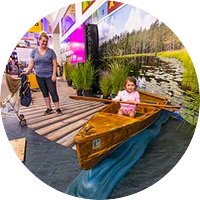
The University of Minnesota’s Water Resources Center (WRC) provides leadership in freshwater management through cutting-edge research, educational opportunities for students and professionals, and community outreach. Authorized by Congress as one of the nation’s 54 water resources research institutes, the Center connects research expertise at the University to research problems at the national level. From monitoring the health of our soils to capturing contaminants in stormwater, WRC experts advance the science of clean water for all Minnesotans through innovation, workforce development and knowledge exchange.
The Minnesota Aquatic Invasive Species Research Center (MAISRC) aims to protect Minnesota’s beloved lakes and rivers by developing research-based solutions that prevent AIS spread, control populations, manage ecosystems and inspire citizens to take action. Want to help? Become an AIS Detector. You’ll learn how to report invasive species, best practices for preventing the spread of AIS, relevant rules and regulations, and how to search for AIS on your own.
Minnesota’s Legacy of Awesome Apples

The University of Minnesota has released 29 apple varieties since its research began more than 150 years ago. According to a CFANS Insights survey, more than half of Minnesotans call Honeycrisp their favorite apple!
Minnesota Hardy researchers aren’t just creating our state’s favorite homegrown apples, they’re creating a fruitful economy with cold hardy strawberries, blueberries, grapes, flowers and other plants that form the foundation of Minnesota’s thriving horticulture industry.
References for Gopher It trivia
Learn more about the science behind the trivia questions.
💩 Manure and the microbiota
- Human Microbiota Transplant: “Microbiota transplantation restores normal fecal bile acid composition in recurrent Clostridium difficile infection” — University of Minnesota-led study on fecal microbiota transplant (FMT)
- Manure as crop nutrients: “Nutrient availability in manure” explains how CFANS researchers measure nitrogen and phosphorus to optimize manure use for crops
- Follow-up work on integrating manure with cover crops: “Manure and cover crops for soil health”
🐄 Burps and agrivoltaics
- “Reducing Methane in Dairy Cattle” explores red seaweed in cow diets to cut burp-produced methane
- WCROC News: “Solar plus cows = green dairy” (agrivoltaics shading cattle under solar arrays)
🦫 Giant beaver
- Meet the Giant Beaver at the Bell Museum - the largest rodent ever to have lived in North America!
🐦 Museum specimens
- Meet the Carcass Crew, a team at the Bell Museum united to support the Salvage Wildlife project — learn more about the members and their work to preserve specimens.
🎣 Gar, a living fossil fish
🤖 Robots doing research
🧊 Ice cores
- Drilling on the edge: To understand the glaciers holding back meters of sea level rise, CFANS climate scientists swoop in to extract ice from Antarctica’s remote west coast
🍎 Amazing apples
- A CFANS Insights survey shows that more than half of Minnesotans (52 percent) claim the University of Minnesota-born Honeycrisp as their favorite, and nearly one-third (32 percent) are willing to pay a premium for it
- The beloved apple variety (designated as the official state apple in 2006) is just one of 29 varieties to sprout from the U of M’s iconic apple breeding program since its inception in 1878.
